Third Week of Lent 2026
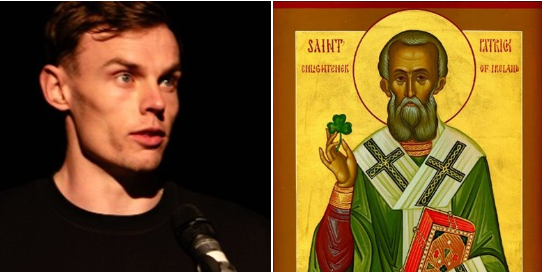
In honor of St. Patrick’s Day, our Lenten reflection this week is a poem by Irish poet Daragh Fleming. May it inspire you to arise, despite the fear, and “point the way, stop the bad guys, save the world, fight the good fight and fix the hurt,” because, God knows, “the good guys need to come.” (To hear Daragh recite the poem aloud, click HERE.)
“Waiting for the good guys”
Daragh Fleming, Cork, Ireland
I’m waiting for the good guys to arrive.
You know, like at the last second
when we think we’ve all but lost,
then they appear on the horizon,
catch our enemies by surprise and
win the day.
Like when Luke and the rebels
destroy the death star and prevail.
They must be on the way.
That moment’s almost here…
but there is this heavy fear
I’ve been trying to ignore
that the age of heroes is no longer.
They’re not coming anymore.
Because we’re corrupted to the point
where both sides are the bad guys in a way.
Vader vs. Maul—
is there any good left at all?
A final Jedi or a knight?
A forgotten king with unclaimed right?
A mother goddess to unite
turn the tide and win the day,
save us all from the darkness we create?
But maybe it’s just us.
Rather than waiting to be saved
maybe we’re the ones who point the way,
stop the bad guys, save the world,
fight the good fight and fix the hurt.
‘Cause the good guys need to come.
And if we can’t see them,
then maybe we become.
Despite the fear, we arise and
appear on the near horizon.
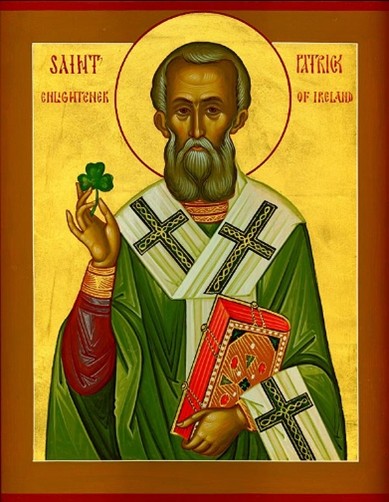
The Feast Day of St. Patrick, which almost always falls during Lent, commemorates his death on March 17, circa 493 CE, in Saul, Downpatrick, Ireland. Since the 9th century CE, Lenten prohibitions against the consumption of meat have been waived for Christians in Ireland on St. Patrick’s Day, and in addition to church services the day includes celebrations with dancing, drinking, and feasting on a traditional meal of cabbage and Irish bacon.
St. Patrick did not die as a Christian martyr, but from natural causes when he was in his mid-70’s. He was born at the beginning of the 5th century CE in Roman Britain. Kidnapped by Irish pirates as a 16-year-old and brought to Ireland as a slave, Patrick escaped and only returned to Ireland later in life to spread the Christian faith. Though his father and grandfather were practicing Christians, Patrick said he was not an active believer in his youth, considering himself “idle and callow.” He wrote in his Confession that the time he spent as an enslaved person was critical to his spiritual development, but after six years in captivity, he heard a voice telling him to go home, so he made his escape back to Britain and returned to his family. He then began his study of Christianity, mainly in France, where he was ordained to the priesthood. He eventually returned to Ireland as a Christian missionary and became a bishop, though as a foreigner and as someone who refused to accept gifts from kings, he remained legally without protection and was sometimes beaten, robbed and even imprisoned, and was frequently the object of ridicule and insult.
St. Patrick is venerated as a saint in the Roman Catholic, Episcopal, and Eastern Orthodox churches.