
Fourth Week of Lent 2026
Flipping Tables or Flipping Out?
The journey through the last week of Lent and into Holy Week includes a stop at the Court of the Gentiles in the temple in Jerusalem, a courtyard bustling with people from all regions and religions. It’s a place where faithful Jewish pilgrims exchange their Roman coins (bearing the image of Caesar) for shekels that they’re allowed to take inside the temple to give as an offering. Sheep, doves, and cattle add to the chaos of the courtyard as they wait to be sold to pilgrims who have come to make required sacrifices of these unblemished animals.
Into the midst of it all walks Jesus of Nazareth, the itinerant preacher whom the crowds adore—while the religious and political leaders, not so much. They see him as a problem to be solved, an obstacle to their continued exercise of power and control, a threat to be neutralized (a protestor our government today would likely label a “domestic terrorist,” right?).
And if the authorities had any doubts about Jesus being a problem for them, what he does next seals the deal. All four gospels say that Jesus starts flipping over tables, sending coins flying in the air and clattering to the cobblestone floor, driving the money changers and the livestock dealers out of the courtyard, all the while quoting scripture about how the temple has been turned into a robbers’ den (because the leaders were taking all that money being collected and using it to exploit poor and desperate people).
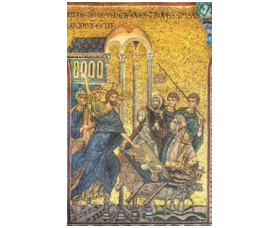
But here’s the thing: most of the essays and articles and sermons and paintings about Jesus’ act of creative resistance and protest created over the past 2,000 years play down the fact that he was angry, furious, enraged. Writers bend over backwards to explain that he was “in total control,” “acting calmly and with intention,” “focused and careful in expressing his dismay.” What?!? And painters go out of their way to portray Jesus as more of a bored theater usher or flight attendant calmly pointing people toward the exits than as someone in a fit of rage:

(Kudos to Rembrandt, who’s an exception to this rule. He went ahead and painted Jesus as someone who was well and truly ticked off:)

So what’s up with this? Why avoid saying or showing that Jesus was capable of feeling and expressing anger? What makes us so uncomfortable with the idea?
Maybe it’s the same thing that makes so many of us these days uncomfortable with our own rage at the inhumanity, cruelty, and injustice that define so much of what the federal government is perpetrating on a daily basis.
Cue the amazing and wonderful social media sensation “Therapy Jeff.”

In a viral TikTok post, licensed therapist Jeff Guenther recently had this to say about our discomfort with anger:
I’m a therapist. And I’m supposed to tell you to take a deep breath and go for a walk. But honestly, f&*% your deep breath. Taking a walk doesn’t help when the air is filled with tear gas. …As a clinician, I see people every day wondering why they feel broken or unproductive. You aren’t broken. You are experiencing a visceral, healthy reaction to fascism. …Stop pathologizing your rage. It’s the only thing that’s still sane right now.
We people of faith would correct one thing about that last sentence: rage is not the only sane thing right now. Love is also a sane thing, and in fact, the kind of rage he is describing actually flows from love. Theologian Richard Rohr has wisely noted, “Anger is a sign that something we deeply love is at stake.” That is why rage can be, as Therapy Jeff says, “a sane thing.”
It’s what Jesus was all about that day in the temple when he flipped out and flipped tables. Something he deeply loved—the well-being of the people of God, especially those living on the margins, vulnerable, persecuted, at risk—was at stake. Those people whom Jesus loved, even to the point of giving his life for them, were being harmed, exploited by the rich, the powerful. And so he got angry.
As his followers, we should feel angry today because people whom Jesus loves—immigrants, unhoused people, women, queer folks, children, people who are sick or in prison or both—these people are being harmed, exploited by the rich and the powerful. That should make us angry. Because something we deeply love—and that God deeply loves– is at stake.
So, not only should we get comfortable with Jesus having gotten angry 2,000 years ago, we need to get comfortable with our own rage and fury at what is happening around us right now.
What do you say? Are you ready to be a threat to the corrupt system? When the powerful few at the top are hurting those at the bottom, we, like Jesus, must walk into the seat of power and start flipping over the tables of injustice.