ICE Is Moving More Quietly. Clergy Resistance Is Not
By Bekah Stolhandske McNeel Sojouners Aug 3, 2026
Bee Moorhead was surprised by the turnout at a July 7 press conference in San Antonio, calling for free and fair elections. The event was simple: a group of clergy, standing in front of San Fernando Cathedral on the city’s Main Plaza, announcing their intention to ask individual lawmakers to sign commitments to defend constitutional voting rights. Important work, she knew, but not usually the stuff of headlines. Moorhead has been organizing clergy around the state as executive director of Texas Impact for more than 20 years, and she said she’s accustomed to being all but ignored by the media and everyone else.
“Faith leaders all over the country, and certainly in Texas, keep speaking up and what comes back is, ‘Why aren’t you saying anything?’” she said. But suddenly, there were microphones and cameras. People were listening to what the group of interfaith pastors, imams, rabbis, and priests were saying about the need to protect voting rights. Something was changing.
Moorhead had launched the policy initiative and called the press conference in coordination with national interfaith organizing group Faith In Us, which formed after clergy from multiple faiths in Minneapolis and St. Paul took a visible role in the resistance movement during Operation Metro Surge. In January, when Immigration and Customs Enforcement was overwhelming the Twin Cities, clergy there began to call for sustained national mobilization of their peers. Faith leaders invited colleagues from around the country to come and train with community organizers and unions in Minneapolis.
“Ideally we want them to witness what is happening here and take those stories back to their communities, and also skills for if and when this comes to their communities,” organizer Peter Digitale Anderson told Sojourners in January.
For Texas clergy, the “when” wasn’t a surge, but a growing, relentless pressure on the numerous immigrant communities and Latino communities broadly. It became like a pile of kindling waiting for a spark. When the press conference ended, Moorhead looked at her phone and saw a breaking news alert: Hours before the press conference, 200 miles away in Houston, ICE agents shot and killed Lorenzo Salgado Araujo on his way to work. The spark had come.
One of the pastors involved with Texas Impact called Moorhead almost immediately. “What are you going to do?” he asked her.
Prophets of policy
Ordinarily, Moorhead said, she tries to steer Texas Impact away from individual incidents, tragedies, and sad stories. She’s wary of allocating attention only to those stories that are already being picked up by the media. She’s wary of stoking outrage without a tangible goal for change.
In Texas, where conservative politicians control most levels of government and protests are met with little more than increasing police presence, Moorhead feels called to be shrewd. Salgado Araujo’s death was not a singular event, just like Minneapolis was not an isolated skirmish. While the 11 instances in which an on-duty DHS agent or ICE officer has shot someone in 2026 attract media attention, the Department of Homeland Security has acknowledged 20 deaths in ICE custody in that same period. Churches and schools reported ICE monitoring parking lots and apartment buildings. People were afraid to leave their homes. Afraid to send kids to school. Afraid to go to church.

Moorhead felt it was time for clergy to become a fixed presence at the vanguard of the resistance. She aims to ensure the demands of clergy are directed at the politicians who can actually address them—asking state or city leaders to unilaterally end ICE operations would be futile because ICE is a federal agency.
But she said the state government does have a role to play in how the actions are carried out within its borders and what happens to immigrants in ICE custody. So she started working on concrete policy responses to ask for from state-level offices in Texas.
On July 22, clergy announced their policy agenda at the Texas Capitol, again to a surprising scrum of media. The state could once again assert its authority to regulate and inspect detention centers, which currently operate as black boxes to all but the increasingly unaccountable DHS. It wouldn’t be much, she acknowledged, but it would increase some level of pressure.
Presence in protest
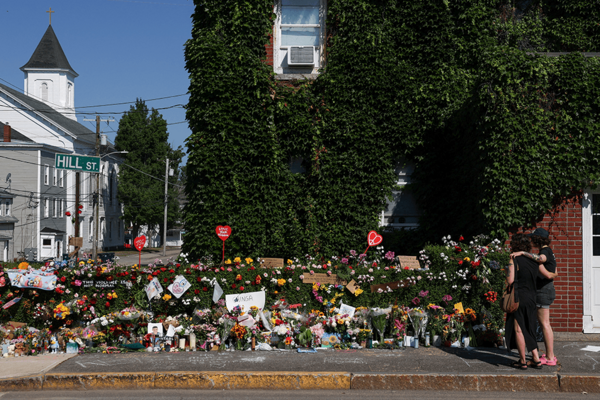
The day after Texas clergy set their sights on policy, a clergy group in Maine reaffirmed their prophetic role on the front lines of physical protest, driven by the same tragic feature of ICE’s increased activity in American cities. On July 13, an ICE officer shot and killed 25-year-old Johan Sebastián Durán Guerrero during a traffic stop in Biddeford, Maine, just south of Portland.
As ICE action in the city increased, Rev. Jane Field, the executive director of the Maine Council of Churches, said clergy responded in kind with increased organizing. The Portland area is home to several large immigrant communities and became the target of an ICE surge at roughly the same time as Minneapolis. ICE dubbed the action in the coastal community “Operation Catch of the Day.”
In October, Field said, a local factory asked clergy if they would come and watch over the arrivals and departures of workers, as ICE began to patrol parking lots outside workplaces known to employ immigrants. Every morning and evening for weeks, Field said, clergy would meet, link arms, and form a corridor from the parking lot to the front door for workers to pass safely.
She said that during the surge, as ICE snatched people from their cars, a group of Quaker women organized a recovery plan and spent the night hours retrieving vehicles and returning them to the families who were now barricaded in their homes.
After the death of Durán Guerrero, protests broke out around the state, and a local group asked if clergy would attend their rally at an ICE facility in Scarborough. As the group of around 250 began to chant, an angry counterprotester with a handgun, hunting knife, and can of Mace visible on his belt began shoving and screaming at the protesters. Videos of the events show orange-vested safety marshals trying to isolate the man, who continues to escalate.
The organizers asked clergy to begin singing to try to calm the crowd, who eventually formed a single-file line to disperse the tension. Clergy formed the familiar linked-arm chain around the stage to allow speakers to continue while the counterprotester continued shoving and spitting on them. At one point, Field said, a rabbi caught sight of a woman in the crowd who slipped her hand onto the man’s gun and removed the clip before disappearing with it into the crowd.
“The clergy who made the choice to form the wall probably felt a little safer knowing the gun wasn’t loaded anymore,” Field said, but the knife and the Mace were still inches away from their bodies. “It was terrifying and traumatic, but nothing compared to what our immigrant neighbors feel day in and day out.”
Shortly after, New Hampshire-based Episcopal Bishop Rob Hirschfeld traveled to Portland to partake in a vigil and encourage clergy. Hirschfeld turned heads in January when he told fellow clergy to prepare for a new era of martyrdom.
“I’ve asked them to get their affairs in order to make sure they have their wills written,” he said, “because it may be that now is no longer the time for statements, but for us with our bodies to stand between the powers of this world and the most vulnerable.” Hirschfeld’s presence after the violent event was a sober, if encouraging, reminder, Field said.
“The stoles and the collars really do have power,” Field said.
Claiming moral authority
What “stoles and collars” communicate may be one of the most important variables in state-by-state organizing and have significant bearing on what the prophetic role looks like for clergy members as individuals and as a movement.
In Texas, no one knows better than Dan De Leon how difficult it can be to stand up for his understanding of Christian values over the din of right-wing Christian politics. De Leon is the pastor of a United Churches of Christ congregation in Bryan-College Station, perhaps one of the most conservative localities in Texas, and home to Texas A&M University, considered by some to be a bastion of conservative higher education.
Though his church has been LGBTQ+-affirming and actively advocating for various social justice issues for many decades, he said, people are always surprised to find them. They assume his church, Friends Congregational, is either Quaker or part of the nondenominational Churches of Christ, which is far larger in Texas.
“It makes it hard to get legitimacy in an area steeped in tradition,” De Leon said.
Speaking as one small voice might be novel, but it’s difficult to create the kind of mass movement that could match the power of the Southern Baptists and evangelical megachurches where Texas’ Republican politicians often visit not only the pews, but the pulpits. To act locally, he said, he often finds common ground with churches that are theologically more conservative but interested in ministries like food pantries and diaper drives. If he brings up the policies behind the need for grocery assistance, he said, the other churches shrink back.
De Leon’s church views immigration as an issue of biblical hospitality, he said, but he knows that for any kind of advocacy work, he’ll need to be linked to a network beyond Bryan-College Station. He stays connected to Texas Impact and its strategic approach to advocacy—in fact, he was the pastor who called Moorhead and began working to organize a second press conference.
Things are different in Maine, where Field said faith leaders don’t have many loud, local voices to compete with. In 2017, the Barna Group listed Portland-Auburn, Maine, as the most “post-Christian” in America, and clergy say the past 10 years of Christian nationalism have not helped change that relationship. Local pastors have not necessarily been called on to lend moral authority or legitimacy to social justice issues in a place where many find religious affiliation suspect.

What Maine does have are strong organizing groups.
Independent Methodist pastor Sara Ewing-Merrill is technically the founder of Greater Portland Multifaith Clergy Organizing Group, but she prefers the term “instigator.” Immediately after Trump was elected again in 2024, Ewing-Merrill signed up for training with the Industrial Areas Foundation, a national network of community organizers. After the inauguration, she began to reach out to other faith leaders in Portland whom she knew were looking to take concrete action.
“I didn’t want to spend the time handwringing,” Ewing-Merrill said.
The group began meeting, sharing what their congregations were doing or interested in doing to support their immigrant neighbors. By emphasizing local camaraderie instead of looking to their denominations alone for support, Ewing-Merrill said the regular check-ins serve a dual purpose.
First, they prevent duplicate efforts. She welcomes churches and clergy with a newfound passion, but she’s equally passionate about helping them figure out who is already doing the work they want to do. A church may want to start accompaniment, meal delivery, and so on. Their work will be more effective if they join those already practicing that work. Second, there’s sharing of challenges and solutions and stories, which helps with the loneliness many clergy feel in a city like Portland where congregations—and thus church staff—tend to be small.
“We’re all nearly burnt out all the time,” Ewing-Merrill said. “We feel like now we have colleagues.”
Field was surprised when the group organizing the demonstration at the ICE facility asked clergy to be involved.
“That hasn’t happened before,” she said. “They’ve been highly skeptical of us, and rightly so.”
Many of the organizers had stories of personal hurt in churches, while others were primarily exposed to religion through the loud national voices of Trump’s evangelical supporters.
When they called, Field said, they were not just looking to boost their numbers.
“They said, ‘We realize we need you people here to keep the tone and tenor nonviolent and focused on deeply meaningful ways for people who show up.’”
When clergy arrived at the demonstration site, she said, the organizers put them up front, in the most public-facing positions of the group. This was a key strategy in Minnesota, said Todd Lippert, a United Church of Christ pastor and organizer with Faith in Us.
“We saw how powerful clergy responding across faith could be,” he said. “It was at the center of what led to the regime drawing down ICE agents in Minnesota.”
Texas and Maine have vastly different relationships with both churches and unions, yet are both actively organizing in response to “ICE’s cruelty and violence,” Lippert said. It’s a testimony to how morally unambiguous the moment has become.
“In different states, the dynamics are different,” he said. “But clergy are desperate to act.”
Pastoral ministry in the resistance
For many pastors, prophetic witness begins at home, helping their congregations see the lives of immigrants as connected to their own. Many congregations become involved in anti-ICE actions on behalf of people who do not speak their language, most of whom they will never even meet. But for others, the need for public action has come from the increasing anxiety and desperation in their congregations. In order to be good shepherds, they are finding that they must speak up for the sheep.
For the past year, Ricardo Jimenez-Reyes has been driving all over South Texas, looking for ways to support the Latino churches in his synod of the Evangelical Lutheran Church in America. Clergy accompany congregants to immigration court hearings and ICE check-ins. They deliver food to those too scared to leave their homes, help community members find attorneys, and host “Know Your Rights” trainings. He often helps pastors figure out how to make their congregations places of emotional safety for their neighbors whose mental health is wearing thin under the constant pressure.
“The fear and the anxiety in this community is incredible,” he said. “It’s not just the detentions, it’s the uncertainty.”
Then one day, Jimenez-Reyes got a call from a church staff member in San Antonio. That Sunday after the Spanish-language service, ICE had been waiting in the parking lot. They followed a man and his two children to their car and tailed them out of the parking lot, the staff member said. The family made it home without incident, but the entire congregation panicked.
Jimenez-Reyes talked to the English- and Spanish-speaking staff, and the church ultimately decided to change their schedule. Instead of hosting the services back-to-back, they now conduct both simultaneously, so that the two congregations mix in the parking lot, making it harder to identify and isolate any one person ICE might be looking for. Still, he said, many haven’t been back to church since.
This fit something Jimenez-Reyes had been noticing—a shift in ICE tactics. On his last few trips to the immigration courts, the white buses were not lined up outside, nor were there armed immigration officers in the hallway, as there had been since May 2025.
“It’s getting more sophisticated and secretive,” he said.
The operations were quieter but more frequent. His observation is backed by data—in June, ICE reported 43,000 arrests, the highest total of any month in the Trump administration.
The increasing violence of ICE actions is raising another pastoral question as well. In College Station, De Leon is feeling the need to pastor his own congregation, made up almost entirely of U.S. citizens, toward solidarity with migrants. Watching what happened in Minneapolis, he’s been feeling sober about what solidarity means.
Providing meals, diapers, and material support feels obvious, he said, and has for a while. But as the situation worsens for immigrants, with more deaths in custody and increasing revelations about the conditions inside the detention centers, it’s becoming clearer that riding out the administration might not be possible. The time may come, as Minneapolis’s pastors predicted, when their city takes to the streets. It’s one thing for clergy to stand on the line, to put their bodies in harm’s way to protect the vulnerable, De Leon said, but he feels it would be a heavy weight to ask his congregation to put themselves in danger.
‘Such a Time as This’
In November 2024, after Trump was elected, Field pulled two books from her shelf. One was by Dietrich Bonhoeffer, the famous German pastor who was executed for his role in the Confessing Church’s resistance to the Nazis. The other was the daily devotional For Such a Time as This by Hanna Reichel, which explores the Christian calling during times of social upheaval, authoritarianism, and oppression. Field said she’s always been inspired by historical resistance movements.
“I never would have thought that would be what we have to do here.”
As daunting as it is, Jimenez-Reyes said, the urgency of the times has clarified his calling. Pastoral ministry is his second career—he was a clinical psychologist before—and before last year, he had started to wonder if he’d made the right choice. He wondered if ministry was as relevant as his clinical work. Now, as he delivers meals, walks with people into courtrooms, and joins other clergy pressing for policy change, he said, “I don’t struggle with that anymore.”
As the church finds more ways to stand with those oppressed by the state, Jimenez-Reyes said something that echoed in the stories of pastors across the country: “I feel more called than ever.”